CASE STUDY:
Buck Mason Women’s
Helping a cult-favorite men’s brand launch a women’s line, which quickly became a must-have of its own (and now accounts for 30% of the business).
BRAND LAUNCH
CONCEPT WRITING & COPYWRITING
BRAND VOICE & TONE REFINEMENT
EMAIL & SOCIAL MARKETING
PRINT CATALOG COPY
The client
Buck Mason launched in 2013 with a new take on American-made menswear and a knack for resonant storytelling.
In 2021, the brand launched Buck Mason Women’s to expand into new markets and reach new, discerning customers who value the quality of heritage pieces.
The challenge
I was brought on in 2021, ahead of the women’s launch, to support Buck Mason’s Copy Director (see his testimonial below) and Buck Mason Women’s Head of Design & Creative. The challenge was interesting: How could we tell a brand story that felt distinct and unexpected while also aligning Buck Mason Women’s with the well-established (and well-known) voice & tone of Buck Mason Men’s?
The objective
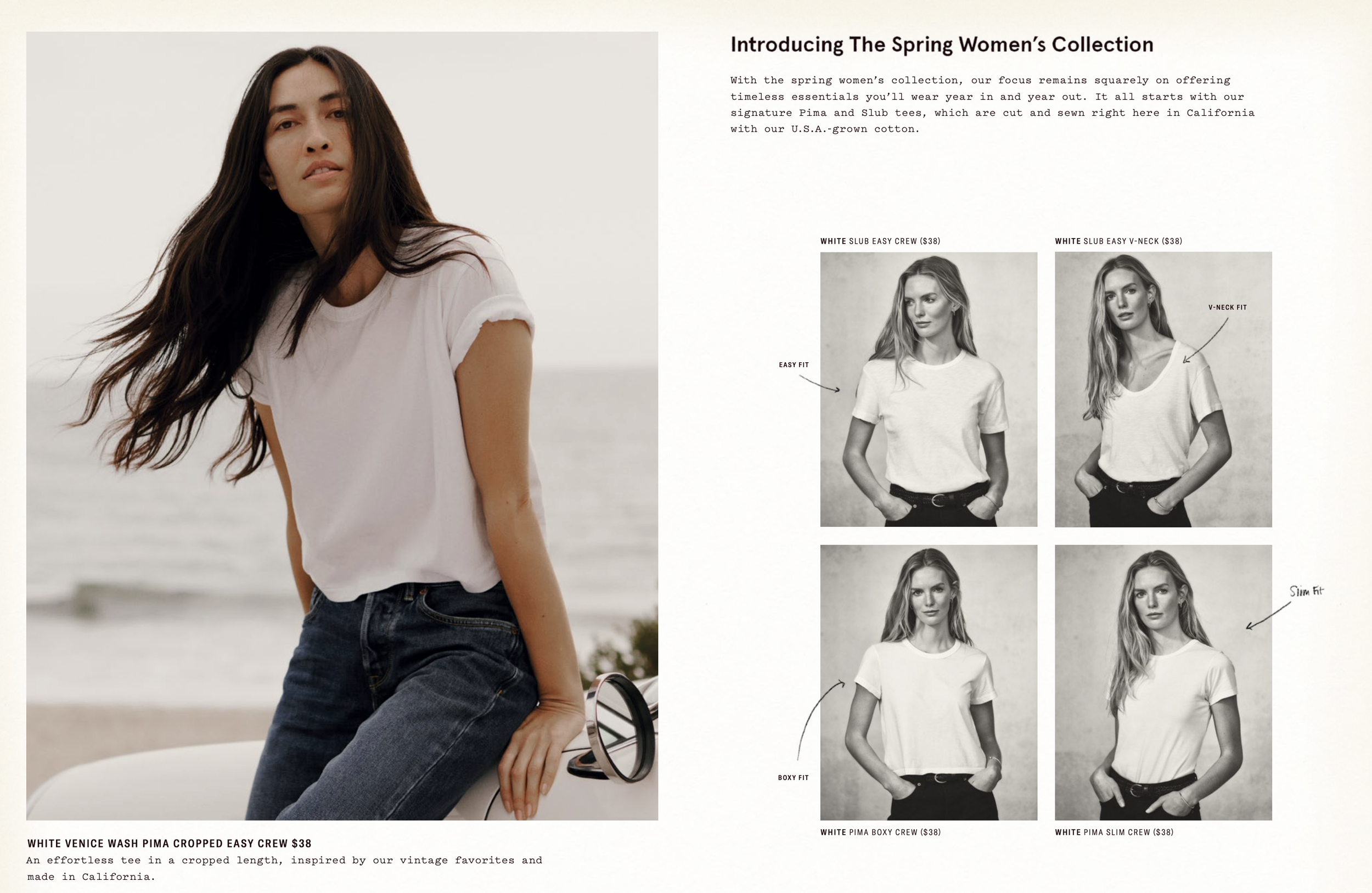
Launch the first Women’s collection with a cohesive voice & tone that would flow easily from platform to platform. That included a deep research phase in which I worked in tandem with Buck Mason’s Copy Director to explore external references, from Isamu Noguchi to Jane Birkin. Then, I wrote all product descriptions and relevant site copy, dedicated Women’s email campaigns, paid and organic social media copy, seasonal catalogs, and other “suprise and delight” one-off projects, such as A-Frame signs for enticing sidewalk traffic into new stores. Check out project examples here.

The Results
Since launch, copywriting and storytelling have played a pivotal role in establishing brand awareness and translating directly into the brand’s bottom line. I worked for Buck Mason through the release of five seasonal collections, as they refined Women’s voice & tone, honed the storyline, and established the line as a new American classic.
Buck Mason Women’s 2-3x weekly emails consistently outperformed industry open and click-through rates. The brand also saw immediate returns, generating mid-six-figure revenue in the first year and doubling it in year two.
As of 2025, Buck Mason Women’s now accounts for 30% of the brand’s business and continues to grow with “days when one women’s product will sell three times more than any other unit in men’s,” according to brand co-founder Erik Allen Ford.
How we did it
-

no copy too small
Everything about Buck Mason emphasizes attention to detail, from the subtle fit of their classic white tee to the carefully curated archival vintage pieces the team collected and used as reference points for new Women’s styles.
Rather than treating product descriptions and site micro-copy as an afterthought, I worked closely with the Creative team to ensure that every word about Buck Mason Women’s felt like Buck Mason Women’s.
-

storytelling gets physical
Buck Mason’s stores have garnered a reputation for being an experience — vintage cars, whiskey pours, and the like.
When it came to growing Women’s, it was equally essential to use copy to bring the same vibe & feel into brick-and-mortar stores and even customers’ mailboxes.
I worked on everything from cheeky sandwich-board copy to unexpected micro-copy for product tags to Buck Mason’s print catalogs, all to inspire and delight potential in-store customers.
-

his & hers
Buck Mason Women’s voice & tone needed to strike an interesting balance: it needed to feel like Buck Mason while also feeling delightfully new for discerning women shoppers. Even as a brand new entrant, the goal was to evoke nostalgia — the Creative team wanted the line to feel heritage and timeless, even if the founding year was 2025.
To set the mood, we leaned into backstory and emotional resonance, particularly in email marketing.
-

technically, yes.
The perfect white tee or the perfect pair of jeans is notoriously hard to find. To garner immediate attention in those categories, Buck Mason Women needed to walk the walk—specifically, the team wanted to lean into their technical expertise. That meant avoiding getting too cute or clever with copy (this is not Reformation) and not shying away from fabrication and fit. It also meant standardizing product description copy for both Men’s and Women’s to avoid branding inconsistencies.
HOW CAN I HELP?